
Where wallpaper suits a Wellesley house
Wallpaper in Wellesley, MA tends to start in the same few places, because the houses share a shape. The older colonials and shingle-style homes found on so many Wellesley streets have a front hall that opens onto a stair, a dining room off to one side, a powder room tucked under the stairs, and bedrooms above with sloping ceilings on the top floor. Each of those rooms takes paper well, and each asks something different of it.
The front hall and the stair
The hall is the first thing anyone sees, and in a colonial it usually runs straight up the stair to the landing. A pattern here sets the tone for the whole house. Because the wall is tall at the stair and broken by doors at the bottom, the paper needs a repeat that reads well both close up and from the floor below, and it has to be planned so the pattern lines up as it climbs.
Dining rooms and powder rooms
These are the rooms where people are most willing to be bold. A dining room is used mostly by lamplight, so a deeper colour or a large-scale print looks rich rather than heavy. A powder room is small enough that a strong paper costs relatively little to try and makes a big impression for its size.
Walls broken up by windows
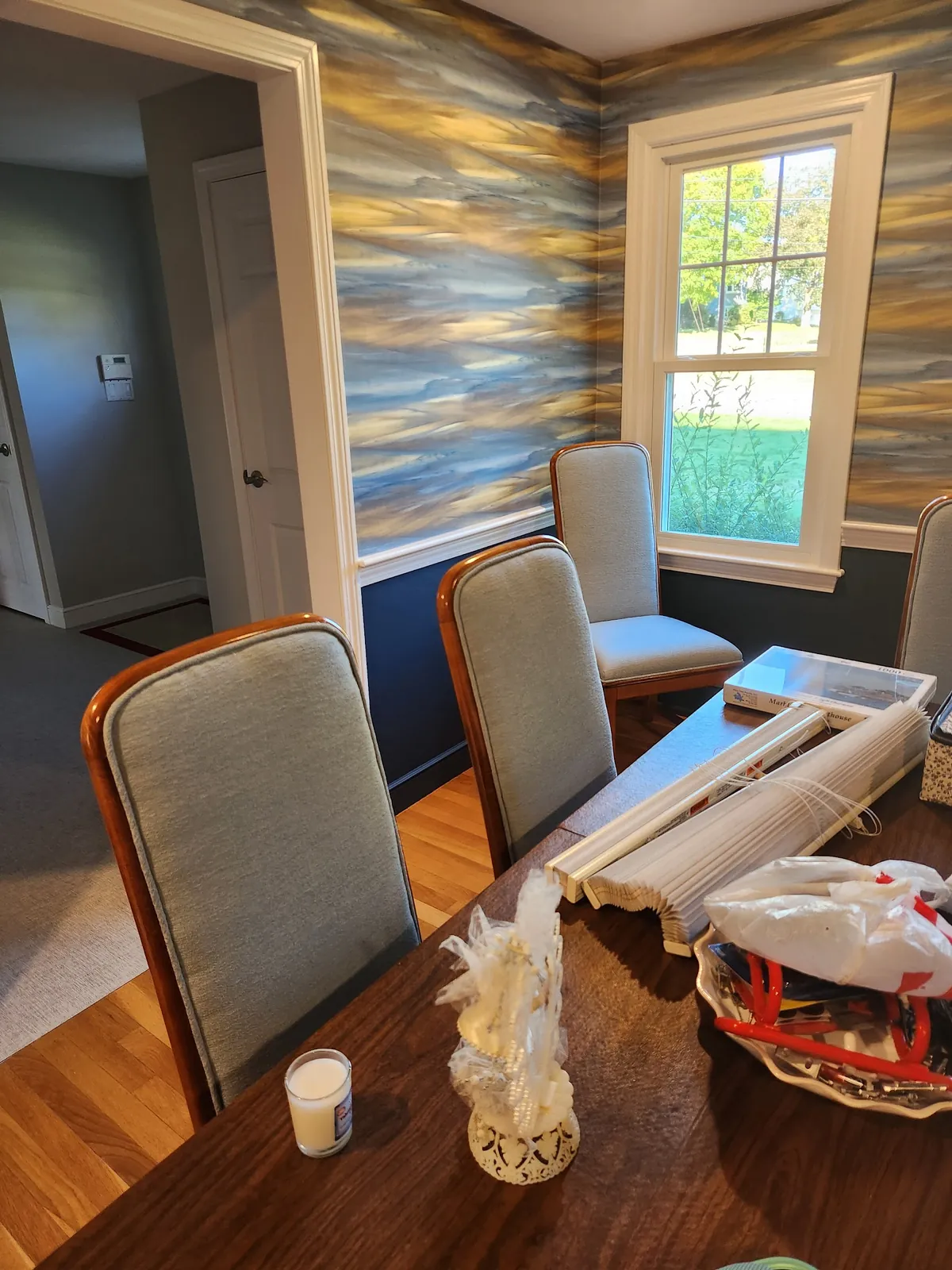
The high window counts in many Wellesley houses change how a room papers. A living room with windows on most of its walls has less plain wall than it seems, and much of what there is sits in narrow strips between openings. A busy pattern can look chopped up in a room like that, while a quieter design, a stripe or a texture lets the windows lead. We think about this with you before you fall for a paper that suits a different room better.
Wallpaper lines on our shelves
Thibaut, Schumacher and Phillip Jeffries
Three of the names people ask for most. Thibaut and Schumacher bring colourful, pattern-led collections; Phillip Jeffries is known for natural and textured wallcoverings.
Morris & Co, Sanderson, Anna French and Clarke & Clarke
English houses with long traditions of printed florals and botanicals. All four also make fabric we carry, so a room can share a design between the walls and the windows.
York, Brewster, Seabrook, Wallquest, Chesapeake and A-Street
A broad run of American lines covering everything from simple textures to bold prints, useful when a project needs papers for several rooms at once.
Kravet, Fabricut, Avant Garde, Pacific Designs, Advantage and Unique
More collections to round out the range. Kravet and Fabricut also appear on our fabric list, which helps when drapery is part of the plan.
Benjamin Moore for the trim and the ceiling
Paper and paint chosen together, at the same counter, so the woodwork and ceiling colour sit right with the pattern.
Since 1947: a wallpaper store at heart
Betty and Joseph Greenberg opened Debsan in 1947 at 32 Summer Street, selling wallpaper and paint to Natick and the towns around it. The store has grown since then to include window treatments, drapery and flooring, but wallpaper is where it started, and the shelves of sample books are still one of the first things you see when you walk in.
That history matters in a practical way. Choosing wallpaper well is mostly about knowing what to ask: how the pattern repeats, how it will look at the scale of your room, how it will sit with your trim colour and your floors, and how much you really need. Those are the questions we work through with you, whichever line the paper comes from.
How we plan a Wellesley room for wallpaper
Getting the quantity right is half the job. Too little and you are left waiting for more, with a risk that the new rolls do not quite match the first. Too much and money sits in the cupboard. Here is what goes into the plan.
- The height of each wall, measured at more than one point, because older floors and ceilings are rarely parallel.
- The width of each wall, and the doors, windows and fireplaces that interrupt it.
- The pattern repeat, which is how far down the roll the design takes to start again. A large repeat means more paper is lost each time a length is cut to match the one beside it.
- The match type. A straight match lines up across the same height on each length; a drop match steps the design down on alternate lengths, which uses paper differently.
- Any feature that changes the plan: a sloping ceiling on the top floor, a chair rail that splits the wall, a stair wall that climbs from the hall to the landing.
From those, the number of rolls can be worked out properly rather than guessed. For any room, we suggest ordering everything together so the rolls come from the same print run, because colour can vary slightly from one run to the next.
Walls in older Wellesley houses
Many older colonials have plaster walls, and some have layers of old paper or paint underneath what you see today. Wallpaper shows what is beneath it, so the wall needs to be sound, smooth and properly primed before any paper goes up. If you are not sure what your walls are made of, or what is under the current finish, mention it when we talk and we will tell you what to look for.
Shingle-style houses often have rooms under the roof with dormers, knee walls and sloped ceilings. These can be lovely papered, and a small, all-over pattern is usually the easiest to carry across the angles, because it hides the places where the pattern meets the slope.
Hanging the paper
A good paper deserves a careful hang: walls prepared, lengths cut in order, seams butted tight and the pattern matched at every join. When you order, we talk through installation for your job and what needs to happen to the walls first, so the paper goes up the way it should.
Wallpaper as part of a whole-house plan
In a large house with many rooms, wallpaper is rarely chosen in isolation. Whole-room and whole-floor projects are common in Wellesley houses of this size, and that is exactly where a design center with several lines in one place is useful. You can choose the paper for the dining room, the drapery fabric for its windows and the Benjamin Moore colour for its trim and ceiling at the same table, and see them together before anything is ordered.
A few ideas tend to work well across a house:
- Let the front hall set a colour that the rooms off it can pick up, in paint or in a quieter paper.
- Give the rooms you can see from one another a family resemblance, such as a shared colour or a similar scale of pattern, even when the papers themselves are different.
- Keep the boldest papers for rooms with a door you can close: the powder room, the dining room, a study.
- Where a room is getting both paper and drapery, choose one to carry the pattern and let the other support it with colour or texture.
For the thinking behind a room planned as one scheme, see how we coordinate walls, trim and windows. The windows themselves are covered on custom drapery for Wellesley homes.
Papering a house in stages
A large house does not have to be papered all at once. Many people start with the front hall and the dining room, live with them for a while, and then move on to the bedrooms or the study. If you plan that way, it helps to choose the later papers with the first ones in mind, even if you do not order them yet. We can keep a note of what went into each room, the lines, the colourways and the trim colour, so the next room picks up where the last one left off.
Working with your designer
If an interior designer is leading the project, bring their selections and their plan. We can source papers from the lines we carry, check the quantities against the rooms, and keep the trim colour and any drapery in step with the walls.
Visiting the showroom, or a consultation at home
Browsing in Natick
To see the whole range, come to the showroom in downtown Natick. The sample books are on the shelves, and there is no substitute for turning the pages yourself: seeing a pattern at full size, feeling the texture of a natural wallcovering, and noticing how a colour shifts between the shop light and the window. It helps to bring what you can from the room, such as a photo, a paint chip from the trim or a swatch of the curtain fabric. Directions are on the contact page.
Planning the room where it hangs
We also offer a free in-home consultation. It is the best way to plan a room where the light, the window positions and the trim all matter, which in an older Wellesley house is most of them. We see the room as it is, talk through the kind of pattern and scale that will suit it, and look at how paper will work with the windows, the doors and the ceiling. If the project includes drapery or window treatments too, we can plan the windows at the same visit. You can read more about how the visit runs on our in-home design consultation page.
Beyond the four walls
Wallpaper does not have to cover a whole room to make a difference, and some of the most useful jobs in an older house are small ones.
Ceilings
A papered ceiling suits a dining room or a bedroom with a plain, well-proportioned ceiling, and it draws the eye up in a way paint cannot. A soft pattern or a gentle texture works best overhead. In shingle-style houses with sloped ceilings on the top floor, papering the slopes along with the walls can make an awkward room feel deliberate.
Inside bookcases and behind shelves
Many older Wellesley colonials have built-in bookcases beside the fireplace or china cabinets in the dining room. Lining the back of them with paper is a quick way to add colour and pattern without committing a whole wall, and it needs very little paper.
Below a chair rail, or above it
Where a room has a chair rail or panelling, paper can go above it with paint below, or the other way round. A striped or small-scale paper below a rail, with a plain colour above, is hard-wearing in a hall. A larger pattern above painted panelling suits a dining room.
Natural and textured wallcoverings
Not every wallcovering is a print. Grasscloth, woven and textured papers bring depth without pattern, and they suit living rooms and studies where the windows and the furniture are the focus. They do have their own needs: natural materials vary from length to length, seams show more than on a printed paper, and they are not the best choice for a busy hall or a bathroom with a shower. We will tell you plainly where they work and where they do not.
Choosing a pattern that suits the room
A few practical points help narrow down a sample book quickly.
Scale is the first. A large pattern in a small room can feel crowded, though in a powder room that can be the point. A small pattern on a big wall can read as texture from across the room, which is often what you want in a living room with lots of windows. Look at the sample from the far side of the room, not just at arm’s length.
Light comes next. A north-facing room takes on a cooler cast, so a warm paper can balance it, while a sunny south-facing room can take cooler greens and blues without feeling cold. Rooms used mostly in the evening, like the dining room, should be judged by lamplight as well as daylight.
Then think about what else is in the room. A busy rug, a patterned sofa or a gallery wall of pictures will compete with a strong paper. A room with plain furnishings can carry much more pattern on the walls.
Finally, think about wear. A hall or a mudroom by the back door sees hands, bags and the odd bump, so a paper that can be wiped is worth having there. A bedroom or a formal living room can take something more delicate.
Living with wallpaper
A well-hung paper lasts for a long time with very little attention. Dust it now and then with a soft, dry cloth or a vacuum brush, working down the wall. If a paper is washable, a damp sponge with plain water will lift most marks; scrubbing or strong cleaners will not do it any good, whatever the label says. Keep a spare roll or a few offcuts from the original order. If a corner ever gets damaged by a bump from the furniture or a move, a patch from the same print run is the only way to repair it invisibly.
In rooms with strong sun, some papers will soften in colour over time, as fabric does. Lined drapery or a shade drawn in the brightest part of the day helps protect both the walls and the furniture, which is one more reason to think about the windows and the walls together.
If you ever decide to change a papered room, ask us before you start stripping. Some modern papers peel away dry and leave a backing that can be papered over; older papers on plaster may need more care to remove without damaging the wall underneath.
Our main wallpaper page has the full list of lines, and the Debsan in Wellesley page brings together paint, flooring, window treatments and the rest for the town.
Questions from Wellesley
Which rooms in a colonial work best for wallpaper?
The front hall and stair, the dining room and the powder room are the most common, because they are rooms people pass through or use for a particular occasion. Bedrooms under the roof can also look lovely with a small all-over pattern that carries across the slopes.
Our walls are old plaster. Can they be papered?
Usually, yes, once they are sound, smooth and primed. Old plaster sometimes needs repairs before papering, and any loose old paper or flaking paint has to come off first. Tell us about the walls when we talk and we will go through what the room needs.
How do we know how many rolls to order?
It depends on the size of the walls, the doors and windows, the pattern repeat and the match type. We work through each of these for the room so the quantity is right, and we suggest ordering it all at once so every roll comes from the same print run.
Can wallpaper and drapery come from the same collection?
Often, yes. Several of the houses we carry, including Thibaut, Schumacher, Sanderson, Morris & Co, Anna French and Clarke & Clarke, make both fabric and wallpaper. We can show you designs that work together, or a plain fabric that picks up a colour from the paper.
Book your free consultation
For wallpaper in your Wellesley house, start from our contact page with a line about the rooms you have in mind. The call button reaches the store directly if you would rather talk it through. Either way, we will arrange a time that suits you.