
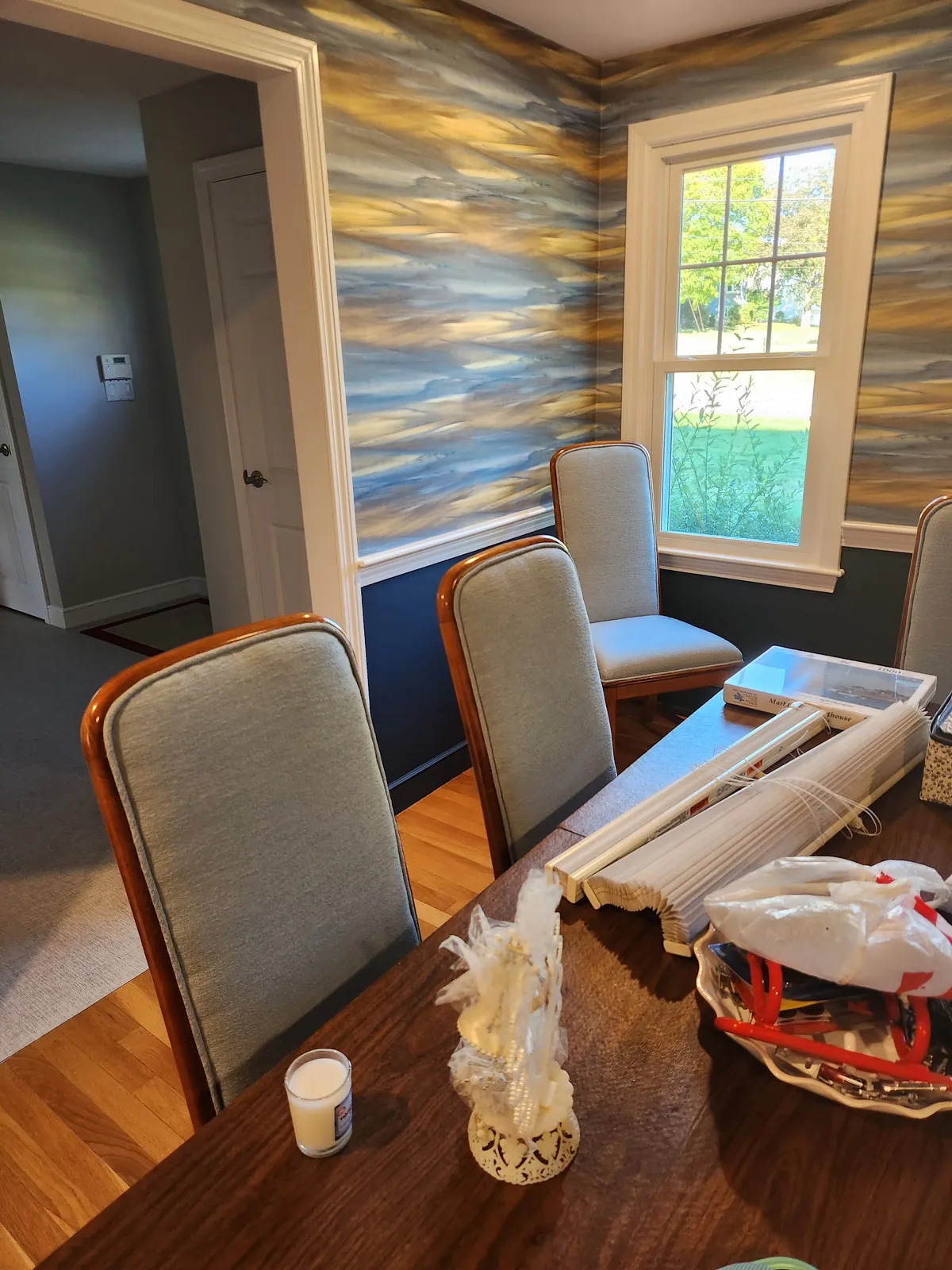
Victorian walls, tall rooms and wallpaper in Newton
Newton has a great deal of the kind of housing wallpaper was made for. If you are looking at wallpaper in Newton, MA, there is a good chance your house is a Victorian or a large colonial, and both bring their own conditions to the job: high ceilings, tall walls, plaster that has been there a very long time, and rooms shaped by bay windows and tall sashes rather than by plain rectangles.
High ceilings change the order
The taller the wall, the more each length of paper matters. On a high Victorian wall, every length is long, the pattern repeat comes round fewer times per drop, and any waste from matching the pattern adds up quickly. Tall walls also show a pattern from a distance, so a design that looks busy at arm’s length can settle into a pleasing rhythm when seen across a big room. We help you judge both.
Bays and tall sashes break the wall up
A bay window turns a flat wall into a set of narrow panels at angles to each other, and tall sash windows leave strips of wall between them that run almost floor to ceiling. Paper has to be cut and matched around all of that. A pattern with a strong vertical line, or a small all-over design, often handles a bay best, because it does not make the angles look uneven.
Picture rails, cornices and old plaster
Many Victorian rooms still have a picture rail some way below the ceiling, with a frieze or plain paint above it, and deep cornices where the wall meets the ceiling. Those details give you choices about where the paper starts and stops. The walls behind are often plaster on lath, which can be beautiful to paper once it is sound and properly prepared.
Newton rooms we help paper
The stair hall
The tallest single wall in many large colonials. A pattern here needs a repeat that still reads well from the hall below and lines up as it climbs to the landing.
The parlour with a picture rail
Paper below the rail and a lighter colour above it suits the proportions of a Victorian front room. Morris & Co and Sanderson designs have a natural home here.
The dining room
Used mostly by lamplight, so deeper colours and larger patterns look warm rather than heavy. A good room to try something bolder from Thibaut or Schumacher.
Rooms with a bay
Small all-over patterns and stripes carry across the angled panels of a bay without looking broken, and leave the window itself as the feature.
Bedrooms and the top floor
Quieter papers, softer colours and textured wallcoverings for rooms where calm matters more than a statement, including rooms under the roof with sloping walls.
The lines we carry
Our wallpaper shelves hold books from these houses: Morris & Co, York, Phillip Jeffries, Brewster, Thibaut, Pacific Designs, Sanderson, A-Street, Schumacher, Wallquest, Anna French, Seabrook, Kravet, Avant Garde, Clarke & Clarke, Unique, Fabricut, Chesapeake and Advantage. New collections arrive through the year, so ask what has come in when you visit.
For a Victorian house, Morris & Co is often the first stop. Its archive holds patterns drawn by William Morris himself, and many of them were made for houses of the same period as a good deal of Newton’s. Sanderson, Anna French and Clarke & Clarke add more English florals and botanicals. The Phillip Jeffries books are full of grasscloths and woven textures, which suit a study or a sitting room where you want depth without pattern. The American lines, including York, Brewster, Seabrook and Wallquest, cover a very wide spread of styles and are a good place to look when several rooms need papering at once.
Wallpaper is where Debsan began
Debsan started in 1947, when Betty and Joseph Greenberg opened a store on Summer Street in Natick selling wallpaper and paint. Over the years the store moved, grew and added window treatments, fabrics and flooring, and today it is owned by the Murphy family. Wallpaper has been on the shelves the whole way through.
What that means for you is simple: when you bring us a room, we know what to ask about it. How tall the walls are, what the light is like, what the trim is painted, what is on the floor, and how the room is used. Those answers narrow a very large choice down to a handful of papers worth taking seriously.
Measuring a Newton room for paper
Ordering the right amount is where most wallpaper problems start or are avoided. Here is how we approach the measurements for an older Newton room.
- We take the wall height at several points, because in an older house the floor and the ceiling are seldom quite parallel, and on a tall wall the difference adds up.
- We measure each wall separately and note every door, window, fireplace and built-in that interrupts it.
- We note where the paper will start and stop: at the ceiling, at a cornice, at a picture rail, or above a chair rail or panelling.
- We look at the pattern repeat and the match type of the paper you like, because a large repeat on a tall wall uses noticeably more paper than a small one.
- We check the stair wall separately, since its lengths vary as the stair rises and each one is cut differently.
From that, the roll count can be worked out with confidence. We suggest buying the whole quantity at once so it comes from one print run; colour can vary slightly from run to run, and on a large wall in good light that difference would show.
Preparing plaster walls
Wallpaper is honest about what lies underneath it. Before any paper goes up, the wall must be firm, even and sealed with a primer made for wallpaper. On older Newton plaster that may mean filling cracks, fixing loose patches, and taking off old paper or flaking paint. It is worth doing well, because a careful job on the wall is what makes the paper look right for years.
Getting the paper on the wall
On tall walls and around bays, the hang needs care: lengths cut in order so the pattern runs true, seams tight, the match kept at every join and around every window. When you order, we plan the hanging with you, including what the walls need beforehand, so nothing holds the job up once the paper arrives.
Choosing paper for a Victorian or a large colonial
Matching the period, or not
Some people want the house to look as it might have when it was built, and for them a Morris & Co pattern above a picture rail, or a Victorian-style damask in a dining room, is exactly right. Others like the shape of an old house but want the rooms to feel lighter and more current. A fresh botanical, a stripe or a textured plain on the same walls gives you that while still respecting the architecture. Neither approach is wrong, and we are happy to show you both side by side.
Scale on a tall wall
On a high wall, a large-scale pattern often looks better than you expect from the sample, because the room is big enough to step back from it. A small pattern on the same wall can read almost as a texture from across the room. When you look at samples, prop them against the wall and step back across the room before deciding, rather than judging them flat on a table.
Colour and the light through tall windows
Tall sashes let a lot of light into a Victorian room, but a north-facing room still takes on a cool cast, while a south-facing bay can be bright for much of the day. Warm colours balance the first; cooler greens and blues sit well in the second. If you are choosing for a dining room, look at the samples by lamplight too, because that is how you will see the room most evenings.
Friezes and the band above the rail
The strip of wall between a picture rail and the cornice was often treated separately in Victorian rooms, with a frieze paper, a border or a plain colour that tied into the ceiling. It is a detail worth bringing back if your rooms still have their rails. A plain wall below with a patterned frieze above lifts the eye toward the cornice and shows off the full height of the room, while a patterned wall below with a quiet band above keeps the room feeling settled. If the rail has gone, a new one can be fitted before papering to restore the proportions, and the paper choice can follow from there.
Trim, floors and everything else in the room
Most older Newton houses have a lot of painted or stained woodwork: casings, baseboards, picture rails, sometimes panelling. The trim colour is part of the wallpaper decision. We carry Benjamin Moore paint, so the paper and the trim colour can be chosen together; our Benjamin Moore paint page for Newton has more on that side. A patterned rug, a busy sofa fabric or a wall of pictures will all compete with a strong paper, so think about what is staying in the room before you pick the boldest design in the book.
Kitchens, bathrooms and back halls
Not every room in an older house is a parlour, and some of the most hard-working rooms benefit from paper too, as long as it is chosen for the conditions.
Bathrooms with a shower or bath see steam every day. A paper with a vinyl or coated surface stands up to that far better than an uncoated print, and good ventilation matters as much as the paper itself. A powder room with no shower can take almost anything, which is why it is such a popular place to try a strong pattern.
Kitchens in Victorian and colonial houses have often been opened up or extended over the years, and the remaining wall space can be limited to a few strips between cabinets and windows. A washable paper there, in a pattern that does not mind being cut up, adds a great deal of character for a small amount of material.
Back halls, mudrooms and the back stair take knocks from bags, boots and the vacuum cleaner. A tough, wipeable paper is the right call, ideally with a pattern busy enough to hide a scuff. Below a chair rail is the hardest-wearing spot of all, and paint or panelling below with paper above is a sensible split.
Older houses and how paper behaves in them
Old plaster and old framing move a little with the seasons, as heating dries the house in winter and humidity returns in summer. A well-prepared wall and a good primer keep the paper stable through that, and a hairline crack in plaster that was properly filled before papering will rarely trouble it later. Rooms that get very damp, such as a basement playroom or an unheated porch room, are better left to paint, or at least discussed with us before you choose a paper.
It also pays to keep a little of what you buy. A spare roll, or the larger offcuts, stored flat and somewhere dry, means a damaged patch can be mended later with paper from the same print run, which is the only way a repair disappears.
Wallpaper, drapery and paint together
A room in an older house often gets redone all at once: walls, windows and woodwork. Choosing them in one place makes that much easier. Several of our wallpaper houses also make fabric, Clarke & Clarke, Morris & Co, Thibaut, Anna French, Schumacher and Sanderson among them, so the paper on the walls and the drapery at a bay window can come from the same or related collections. Alternatively, one can carry the pattern while the other picks up a colour in a plain weave. Our custom drapery page for Newton covers the windows, and our guide to coordinating paint, wallpaper and window treatments explains the approach.
Designers are welcome too: bring their scheme along. We can source the papers from our lines, check quantities against your rooms, and make sure the trim colour and any drapery agree with the walls.
Seeing papers at home, or at our showroom
A free consultation anywhere in Newton
From Auburndale to Newton Highlands, and from Waban across to Newtonville, the free in-home consultation comes to your house. It is the surest way to plan paper for a tall room, because we can look at the light, the trim, the bay and the ceiling height together, and talk about scale while standing in the room. If drapery or other window treatments are part of the plan, we can measure those at the same visit. Our in-home design consultation page sets out what the visit involves.
What the visit settles
By the time we leave, you should have a clear idea of which walls are being papered, where the paper starts and stops in each room, how the pattern will fall around the bay and the doors, and which designs from your shortlist suit the room. Nothing is ordered until you have seen the price and are happy with the choice.
The sample books in Natick
You are also welcome to browse in person at our downtown Natick showroom, where the books sit on the shelves ready to look through. Seeing a design at full size, running a hand over a textured paper and holding a sample up to daylight tell you more than any photo. Bring a picture of the room, a chip of the trim colour or a scrap of the curtain fabric if you have one. How to find us is on our contact page.
Paint, flooring, blinds and the rest of our work in the city are gathered on the Debsan in Newton page.
Questions from Newton
Should the paper go above or below our picture rail?
Either can work. The traditional choice in a Victorian room is paper from the baseboard up to the picture rail, with a lighter paint or a frieze above it. Papering above the rail instead can make a tall room feel more intimate. We can show you both with your samples.
Will a pattern look right on a very tall wall?
Usually better than you expect. A larger pattern often suits a tall wall because you see it from further away. We look at the repeat, the scale and the match type with you, and work out how the pattern falls on your wall height before you order.
Can wallpaper go around a bay window?
Yes, with care. Each panel of the bay is cut and matched separately. Small all-over designs and stripes are the easiest to carry around the angles without the pattern looking uneven, and we will point out which of your choices suit the bay best.
Our plaster walls have some cracks. Is that a problem?
Not if they are dealt with first. Cracks need filling, loose areas need fixing, and the wall needs a wallpaper primer before any paper goes up. Describe the walls in your message and we can talk through what the room needs.
Arrange a visit
To talk about wallpaper for a room in your Newton house, use the contact page to send a few words on the room and the look you are after. If you would rather speak to someone, the call button rings the store. We will find a time to come and see the room, free of charge.